How to read this: Bali Phinisi Charter is an independent concierge guide — we curate and compare boats, then arrange your charter through a vetted operating partner. We do not own or operate the vessels. Prices are by quote and vary by boat, season and group; figures here are indicative. Inclusions, routes and Komodo itineraries vary by operator — confirm specifics before you book. This is general information, not a binding offer.
A bali liveaboard phinisi is a traditional-style wooden yacht chartered for multi-day sailing with overnight cabins, typically 2–7 nights. In Bali, that usually means a private full-boat hire with 4–8 ensuite cabins, all meals onboard, crew included, and flexible routing within a set sailing area.
As Stays & Onboard Editor at Bali Phinisi Charter, I focus on exactly this format: helping you understand what a Bali liveaboard actually is, what it costs, how it differs from a day charter, and how to choose a boat that matches your group and expectations. We guide, compare and plan; we are not the boat operator. Once you decide, we arrange the booking through a vetted local partner.
What is a Bali liveaboard phinisi?
A Bali liveaboard phinisi is:
- A multi-day, fully crewed yacht charter
- On a classic Indonesian wooden phinisi or contemporary yacht in the same category
- With private sleeping cabins and onboard bathrooms
- Sailing from a Bali-area harbour, or used as part of a Bali-based trip that continues in Komodo or beyond
Typical patterns:
- Duration: 2D1N, 3D2N, 4D3N, and longer on request
- Cabin count: usually 4–8 guest cabins
- Guest numbers: commonly 4–14 guests for comfort, occasionally more if families share cabins
- Format: almost always a private full-boat charter, not a join-in ticketed cruise, ex-Bali
If you are picturing a floating hotel that moves a little each day, that is broadly accurate. The key difference from a hotel is that your route, pace and daily schedule are shaped around your group, the weather, and your captain’s safety decisions.
By contrast, a Bali overnight yacht charter that uses a catamaran or small motor yacht might have fewer cabins and a more compact layout, but the principle is the same: private, fully-crewed, overnight on the water.
Liveaboard vs day charter: what actually changes?
Core difference: day trip vs floating base
A day charter in Bali is typically 4–8 hours on the water, returning to shore by sunset. A bali liveaboard phinisi stretches that concept over multiple days, with the boat becoming your base for sleeping, dining and exploring.
You gain:
- Time – multiple dawns and sunsets, not just a single afternoon
- Range – the ability to reach quieter anchorages and time them outside peak day-boat hours
- Pace – no need to rush back to harbour; the boat simply moves on
For locations close to Bali (Nusa Penida, Lembongan, northern Bali bays), day charters are usually sufficient. Liveaboards shine when you want to combine:
- Several islands or coasts
- A mix of snorkelling, paddleboarding, coastal walks and village visits
- Slow time onboard for reading, work or family time without a daily transfer ashore
Guest numbers: fewer people, more space
Day-trip phinisi in Bali are often licensed for 20–60+ passengers, even if you charter the whole vessel privately. The same hull, configured as a liveaboard, will usually host far fewer guests.
For liveaboard layouts we see most often:
- Cabins: ~4–8
- Comfortable overnight guest range: 4–14 guests
- Upper limit: sometimes 16–18, if there are family cabins or bunks and your group is happy to share more tightly
This smaller guest count is the main reason a liveaboard feels more relaxed than a day boat, even on similar-sized vessels.
Cabins and layout: what to expect on a Bali yacht with cabins overnight
Cabin types on Bali liveaboard phinisi
Every boat differs, but there are common patterns for a bali yacht with cabins overnight:
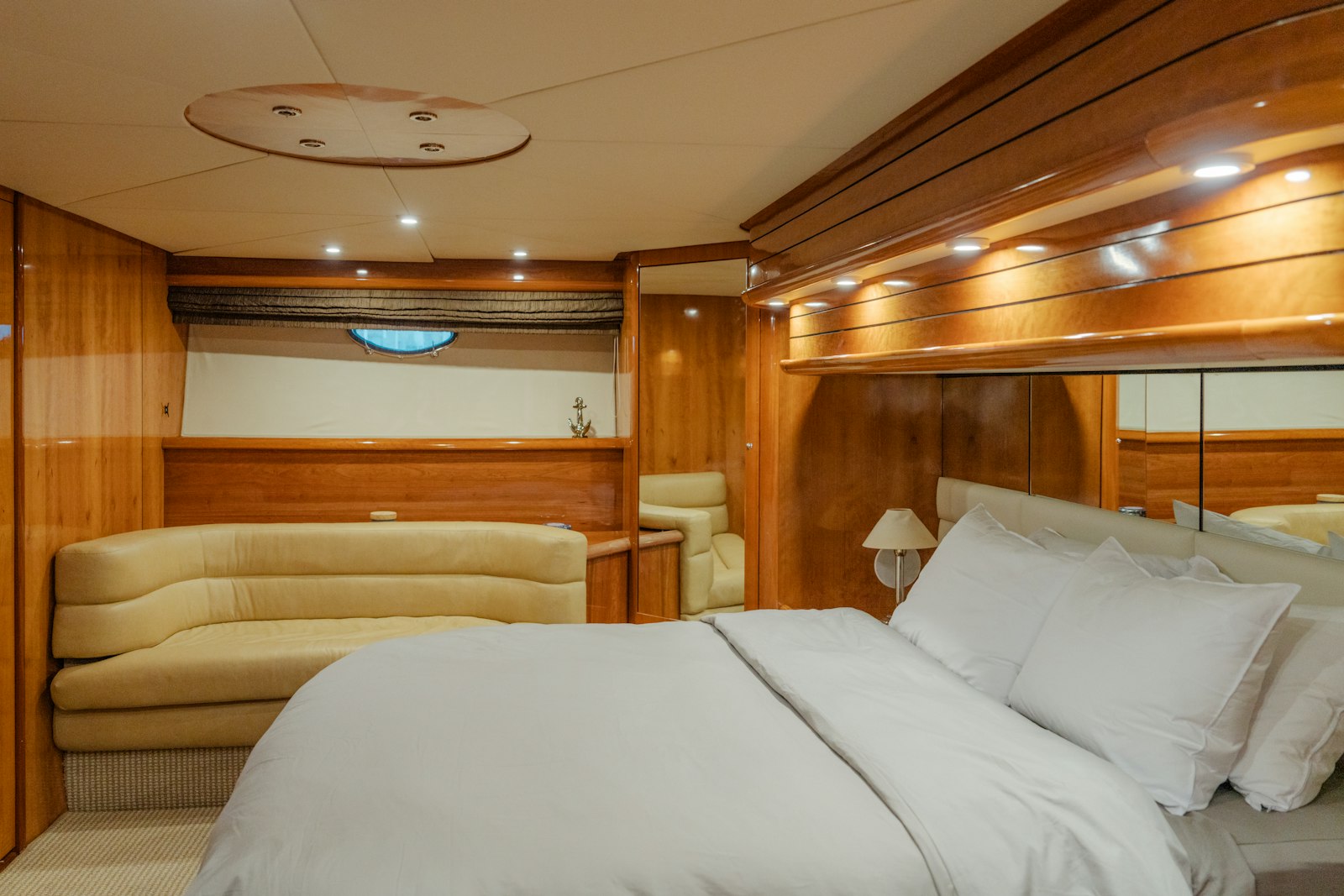
- Double or queen cabins – most common; good for couples or solo travellers wanting privacy
- Twin cabins – two separate single beds, sometimes convertible to a double
- Triple/family cabins – a double plus a bunk or extra single, useful for parents with a child
- Master cabin – sometimes slightly larger, with more windows and a larger bathroom
On traditional phinisi, cabins are usually below or mid-deck with portholes or small windows. Expect:
- Full bedding and towels
- Individually controlled air-conditioning (on most overnight-capable boats)
- Storage space for soft bags; hard suitcases can be harder to stow in some hulls
- Ensuite bathroom with shower, sink, and flush toilet on mid-range and higher boats; some simple vessels may share bathrooms
Shared spaces
The liveaboard difference becomes clear in the communal areas:
- Shaded deck lounge – for meals, reading, working, usually the social heart of the boat
- Sun deck – with daybeds or beanbags for sea-view downtime
- Indoor salon (on some yachts) – useful in rain or strong wind
- Dive or watersports deck – on boats built with diving and snorkelling in mind
If you are comparing options, the shared spaces often affect comfort more than cabin size. For longer trips (Bali 3D2N sailing and beyond), generous shade, comfortable seating and good airflow matter more than square meters on the spec sheet.
Sample formats: 2D1N, 3D2N, 4D3N and beyond
Durations are usually described in days and nights: 2D1N, 3D2N, 4D3N, and occasionally 5–7-night itineraries for more ambitious journeys.
Below is a broad feel of how each format works. Exact routing depends on the boat, season, seas, and port permissions.
Bali 2D1N boat trip
A Bali 2D1N boat trip is the shortest liveaboard format and works best for:
- Quick escape from the south Bali crowds
- A special occasion overnight (birthday, anniversary, small celebration)
- Testing whether you enjoy sleeping at anchor
Typical structure:
- Day 1: Late morning or midday departure from a Bali harbour; sail 1–3 hours to a nearby island or bay; snorkelling and water play; sunset drinks; dinner onboard; sleep at anchor
- Day 2: Breakfast onboard; another swim or snorkel session; unhurried sail back; return to harbour mid-afternoon
Range is generally limited to Nusa Penida / Nusa Lembongan / parts of east or north Bali, depending on where the boat is based. A 2D1N charter ex-Bali is not usually enough to reach Komodo comfortably or safely.
Bali 3D2N sailing
A Bali 3D2N sailing format gives more flexibility:
- Better odds of catching calm early-morning and late-afternoon conditions
- Time to shift anchorages and see different sides of an island
- A more natural onboard rhythm: you settle in on night one, relax fully by night two
For Bali-area routes, 3D2N often means:
- Nusa Penida and Lembongan with multiple snorkel sites, a quiet bay, and one or two land visits
- Sooner or Singaraja coast segments if the boat is north-Bali based
- A mix of moving and “stay put” time rather than simply crossing and returning
For longer-range itineraries that involve flights or re-positioning, 3D2N is also a practical minimum module:
- E.g. 3D2N in Komodo as part of a bigger Bali holiday, with a short flight to Labuan Bajo. Many multi-day Komodo cruises depart Labuan Bajo, not Bali itself.
4D3N and longer liveaboards
From 4D3N onwards, a liveaboard becomes a small expedition:
- More distant anchorages and quieter snorkel sites
- Space in the schedule for weather changes or a “do nothing” afternoon
- Opportunity to layer interests: snorkelling plus village visits plus coastal walks
For Komodo or beyond:
- Most comfortable Komodo liveaboard patterns are 3–5 nights
- Extended itineraries sometimes run 6–7+ nights, usually starting or ending in Labuan Bajo
- A few specialist trips may include crossing segments to or from Bali, but these are sea journeys first and foremost, not simple transfers
If you are considering a Bali luxury liveaboard cruise of 4–7 nights, we usually recommend structuring it around a region (Komodo, Alor, Raja Ampat in the right season) and treating Bali as your pre- and post-sail base, rather than insisting the boat strictly departs from Bali.
Typical inclusions on a Bali liveaboard phinisi
Liveaboard pricing is almost always per-boat, per-night, with a base rate that includes most essentials. Exact details vary by operator, so we verify each boat’s specifics individually, but the pattern is fairly consistent.
Commonly included
- Use of the entire boat and cabins for the agreed number of nights
- Crew: captain, deck crew, cook; sometimes cruise director or guide for larger boats
- All meals onboard: breakfast, lunch, dinner, and snacks
- Tea, coffee, drinking water
- Basic snorkelling gear: mask, snorkel, fins in common sizes
- Fuel for the planned route within a defined radius or hours of cruising
- Standard cleaning and housekeeping (daily cabin refresh or as agreed)
On more activity-focused boats:
- Use of SUPs or kayaks if listed
- Basic fishing gear (hand lines) on some vessels
- Dive deck and tanks / weights on dive-oriented liveaboards; actual dives may be an extra fee
Often extra or variable
These elements are where quotes diverge. They may be:
- Included by some boats
- Chargeable extras for others
- Or simply arranged by you directly
Common variables:
- Alcohol: beer and wine may be available on a pay-per-drink basis; premium spirits sometimes not stocked unless pre-ordered
- Soft drinks: some boats include sodas and juices, others charge modestly per can or bottle
- Airport and hotel transfers: sometimes included from specific areas of Bali, sometimes not
- Marine park fees: particularly important in Komodo and certain protected zones; these are set by the authorities and can change
- Diving: per-dive charges, dive guide fees, or full-course packages, depending on the operator
- National park guides or local village fees: required in some locations
- Fuel surcharges: for longer-than-standard routes or repositioning
- Service charge or tips: occasionally built into pricing; more often discretionary and settled at the end of the trip
We keep a running comparison of what each of our partner boats typically includes, and will spell this out in your quote. For a general overview of inclusions across both day and overnight charters, you may find our overview page helpful: what is included on a Bali charter.
Onboard life: dining, crew and comfort
Daily rhythm
Life on a liveaboard tends to settle into a simple pattern:
- Early morning: coffee, tea, light breakfast; optional sunrise swim or paddle
- Mid-morning: first snorkel or land outing, depending on conditions
- Lunch: served onboard, usually family-style
- Afternoon: second water session, reading, napping, or moving to a new bay
- Sunset: on deck with snacks; golden light at anchor
- Dinner: unhurried, often under the stars
- Night: quiet; usually the generator runs for air-conditioning until a set time, then is switched off on some boats
We encourage groups to discuss early on:
- Generator-off hours and cabin temperature expectations
- Nighttime noise (music volume, if any)
- When you prefer to be up and active vs resting
Clear expectations early make the liveaboard feel intentional rather than improvised.
Food and dietary needs
Most Bali liveaboard phinisi offer:
- A mix of Indonesian dishes (grilled fish, vegetables, rice, satay-style skewers)
- Simple international favourites (pastas, salads, grilled meats or tofu)
- Fresh fruit at most meals
Before sailing, we ask about:
- Dietary needs (vegetarian, vegan, gluten-avoidant, specific allergies)
- Preferences around spice levels
- Any children’s favourites that are easy to provide onboard
Provisioning happens prior to departure, so the more specific you are at planning stage, the easier it is for the boat team to cook meals you genuinely enjoy.
Crew and service style
A typical liveaboard crew includes:
- Captain – responsible for navigation and safety decisions
- Deck crew – handling lines, tenders, watersports gear
- Cook / chef – in charge of all meals
- Guide or cruise host – on many boats; helps plan the daily flow of activities and manages communications
- Dive guide / instructor – on specialist diving liveaboards
Service is not silver-tray formality; think more “quietly attentive coastal hotel” at sea. Crew help with:
- Launching and retrieving tenders
- Fitting snorkel gear and assisting less confident swimmers
- Serving meals and clearing up
- Keeping shared spaces tidy
Tips are not technically mandatory, but they are customary if you are happy with the service. We can advise appropriate ranges based on current norms in Indonesia.
Comfort cues
Comfort onboard is usually shaped less by lux finishes and more by:
- Ventilation and shade on deck
- Generator noise and operating hours
- Mattress quality
- Bathroom water pressure and layout
- The boat’s motion at anchor
If you are sensitive to motion:
- Choose cabins midship rather than right at the bow
- Opt for itineraries that focus on shorter hops and sheltered anchorages
- Avoid peak wind months for your chosen area
You can cross-check general seasonal patterns on our best time to charter in Bali guide.
Bali vs Komodo: where do most multi-day liveaboards actually run?
There is an important distinction that marketing often blurs:
- Many of the classic multi-day Komodo liveaboards start and end in Labuan Bajo, on Flores, not in Bali.
- Bali is your international gateway and holiday base; Labuan Bajo is the harbour town that serves Komodo National Park.
To reach Komodo from Bali, your practical options are:
- A short domestic flight (commonly ~1 hour) from Bali to Labuan Bajo, then join the boat there
- A longer, more expedition-style liveaboard that includes a crossing segment – these are less common, more weather-dependent, and suited to guests who enjoy sea days
For clarity on the Bali–Komodo reality and current routing options, we keep a standing guide here: Komodo from Bali: how it actually works.
If your priority is simply an ocean-front overnight with snorkelling and quiet bays, sailing in the Bali–Nusa Penida–Nusa Lembongan area can be entirely satisfying, without needing to reach Komodo. We can walk through the trade-offs based on your dates and how sea-tolerant your group is.
Seasonality: best time for a Bali liveaboard phinisi
In broad terms, the best season for a Bali liveaboard phinisi is April to October, with nuances by month and region.
Patterns that are widely accepted:
- April–June: Often a sweet spot – seas can be relatively calm, visibility improving for snorkelling, fewer peak-season crowds
- July–August: Dry season, busy holiday months; seas can be windier in some straits (e.g. around Nusa Penida), which can affect comfort for those prone to seasickness
- September–October: Frequently good balance of calm conditions and warm water; a popular period for Bali 3D2N sailing and longer liveaboards
- November–March: Wetter months in much of Indonesia; some boats reposition to areas that are more sheltered this time of year; others schedule maintenance
Weather is never guaranteed, and the micro-conditions around each island and strait can change on short notice. Captains may adjust routes for safety and comfort even in peak months.
For a more zoomed-out view of Bali and nearby seas month-by-month, you can refer to our seasonal overview: best time to charter in Bali.
Price ranges: what a Bali overnight yacht charter really costs
All figures below are intentionally presented as ranges and marked “last verified June 2026”. Liveaboard and fuel prices move with demand, operating costs and exchange rates. We confirm current numbers case by case before you commit.
That said, for planning purposes, private full-boat Bali overnight yacht charter rates per night often cluster in these brackets:
- Smaller / simpler phinisi (4–5 cabins)
- Approx. USD 1,800–3,000 per night, depending on season and inclusions (last verified June 2026). Suitable for smaller groups prioritising being on the water over luxury finishes.
- Mid-range liveaboard phinisi (5–7 cabins)
- Approx. USD 3,000–6,000 per night (last verified June 2026). More space, upgraded fit-out, often better-equipped for snorkelling and family groups.
- Higher-end Bali luxury liveaboard cruise options
- Approx. USD 6,000–12,000+ per night (last verified June 2026). Larger boats, higher cabin quality, more staff per guest, and more toys (SUPs, kayaks, sometimes dive facilities).
Points to keep in mind:
- These are for private full-boat hire, not per-person tickets
- Per-person cost can be surprisingly reasonable for groups of 8–12 sharing a mid-range boat
- Shorter trips (2D1N) sometimes carry a slight premium per night vs longer bookings, as turnarounds are more frequent
- There may be different rates for low, shoulder and high seasons
- Komodo-focused itineraries may price differently to Bali-local itineraries because of park fees, supplies and logistics
If you share your preferred dates, group size, and rough budget, we can usually narrow your realistic options to two or three boats and send a clear side-by-side quote. You can start that process via plan your trip – we also plan and refine details over WhatsApp once we have your initial brief.
Choosing a liveaboard: key decisions
1. Duration and region
Ask yourself:
- Do you want a Bali-area experience (Nusa islands, Bali coastline) or a Komodo / Flores experience?
- How many nights can you realistically be at sea and offline (at least part of the time)?
If your schedule is tight:
- 2D1N or 3D2N Bali-area works well to integrate with a wider Bali holiday.
- For Komodo, we usually suggest at least 3D2N, ideally 4D3N.
2. Group size and cabin configuration
Key checks:
- How many separate sleeping spaces you need vs how many you can share
- Any mobility issues (steep stairs, ladder-style access to some cabins)
- Children’s ages and whether they can safely share upper bunks or smaller beds
Because liveaboard cabins are limited, an accurate headcount is important before we request holds and quotes.
3. Style and comfort level
From simpler to more refined, liveaboards fall loosely on a spectrum:
- Functional and simple: focus on being on the water, less on finishes
- Comfortable mid-range: AC cabins, well-planned decks, thoughtful details
- Higher-end: larger cabins, more privacy between sleeping areas, curated design, and often more quiet
Price usually tracks this, but not always; some boats are mid-priced because of size or operating region, not because of quality. We help align expectations so you are not surprised once onboard.
4. Activities: snorkelling, diving, or “slow sailing”
Clarify your priorities:
- Primarily snorkelling and island exploring
- Serious diving (then a dive-oriented boat is important)
- A quiet “slow sailing” retreat with only light water time
Boats set up for dedicated diving carry different safety systems, compressors, and guides; using a non-dive boat for ad-hoc diving is rarely ideal.
5. Logistics and access
Practical points:
- Departure harbour: south Bali, east Bali, north Bali, or Labuan Bajo for Komodo
- Flight timings if connecting Bali–Labuan Bajo–Bali
- Transfers from your hotel or villa to the harbour and back
We factor in realistic transport timing and suggest where to spend the night before and after your sail to avoid rushing. Our packing notes here may be helpful: what to bring on a Bali boat charter.
How Bali Phinisi Charter fits in
We are a charter editorial and concierge service, not a boat operator.
What we do:
- Curate a shortlist of Bali and Komodo liveaboard phinisi that meet basic safety, comfort and service criteria
- Compare options based on your group size, dates, budget and interests
- Plan the charter details: duration, routing, meal preferences, special occasions
- Connect you to a vetted operating partner who runs the boat day-to-day
No one can pay to change what we publish; if you proceed with our partner they may pay us a referral fee at no extra cost to you.
Our role is to be explicit about trade-offs: comfort vs price, Bali vs Labuan Bajo starts, short 2D1N vs deeper 4D3N exploration. You keep control of the decisions; we reduce the guesswork.
To begin, you can share your dates, group size and rough budget via plan your trip. Once we have that, we typically move the conversation to WhatsApp for quicker back-and-forth on specifics.
At-a-glance comparison: day charter vs liveaboard
| Feature | Bali day charter | Bali liveaboard phinisi |
|---|---|---|
| Duration | 4–8 hours, same-day return | 2D1N to 7+ nights |
| Sleeping onboard | No | Yes, in cabins (usually 4–8) |
| Typical guest count | Up to 20–60+ on some boats | 4–14 for comfort, sometimes 16–18 |
| Meals | Often lunch and snacks | All meals onboard: breakfast, lunch, dinner |
| Range | Close to harbour (e.g. Nusa Penida) | Multiple islands / bays, depending on nights |
| Best use | One active day of snorkelling and sailing | Unhurried multi-day time at sea and on islands |
| Pricing model | Per-boat (or per-person join-in) for the day | Per-boat, per-night, with inclusions bundle |
For a tailored, up-to-date quote on a Bali liveaboard phinisi, including options for Bali 2D1N boat trips, Bali 3D2N sailing, or a longer Bali luxury liveaboard cruise linked with Komodo, you can start a brief via plan your trip. If you prefer, mention your WhatsApp number there and we will continue the planning in a single, clear message thread.
How far in advance should I book a Bali liveaboard phinisi?
For mid-range and higher-end boats in the April–October period, 4–6 months ahead is sensible, especially if you need specific dates or multiple cabins. For shoulder months or simpler boats, 2–3 months can still work. Last-minute space sometimes appears due to cancellations, but it is not something to rely on for fixed-date trips.
Can I join a shared liveaboard trip instead of booking the whole boat?
Some operators do offer cabin-by-cabin join-in trips, particularly in Komodo ex-Labuan Bajo, but ex-Bali departures are more often full-boat private charters. If you are two to four guests and prefer to share, tell us your dates and flexibility; we can check for reputable join-in options that match your comfort level.
Is a liveaboard suitable for children?
Many families charter liveaboards successfully, but it depends on your children’s ages, comfort in the water, and how they manage confined spaces. Boats have stairs, railings and open decks; constant adult supervision is essential. We recommend child-friendly boats with stable layouts, available life jackets in children’s sizes, and itineraries with shorter sailing legs.
Will I have mobile signal and internet on a Bali liveaboard?
You will likely have intermittent mobile coverage near populated coasts and major islands, and weaker or no signal in more remote bays. Some higher-end boats offer basic Wi‑Fi via local networks or satellite, but it is rarely comparable to land-based broadband. If connectivity is critical, tell us upfront so we can align expectations and suggest suitable routes and boats.
What should I pack for a Bali overnight yacht charter?
Soft luggage, light clothing, sun protection, reef-safe sunscreen, a hat, sunglasses with a strap, swimwear, and any personal medications are essential. A light sweater for breezy evenings and non-marking deck shoes or sandals are helpful. For a detailed, boat-specific checklist, we maintain a packing guide here: what to bring on a Bali boat charter.